
Materials & Structure
Olivine cathodes
A research reference for olivine battery cathodes, connecting phosphate structure, lithium transport, LFP and LMFP chemistry with electrode engineering.
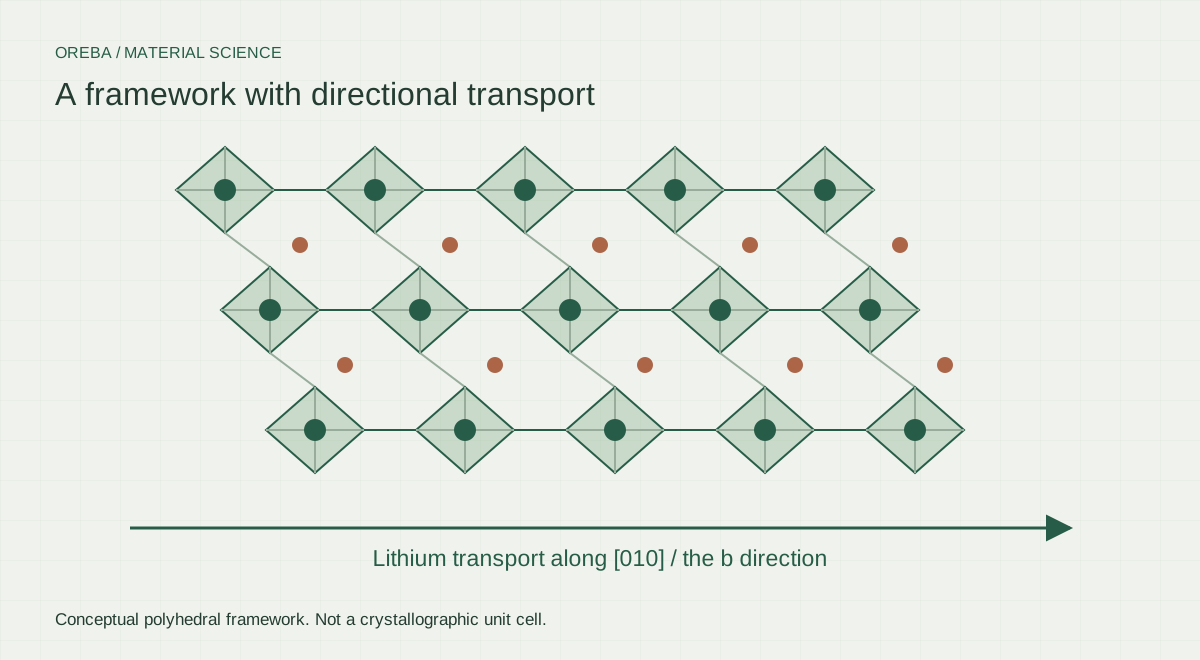
An olivine cathode is defined by its crystal framework as well as its composition. In the rechargeable-battery literature, the best-known example is lithium iron phosphate, LiFePO₄. Its iron redox chemistry stores charge while lithium enters or leaves the phosphate host. Padhi, Nanjundaswamy and Goodenough’s 1997 paper introduced phospho-olivines as positive-electrode materials for rechargeable lithium batteries. [1]
The same family includes materials with different transition metals and mixed compositions. They share structural questions without having identical operating voltages, kinetics or stability. The 2024 review by Hwang and colleagues connects these differences to particle and electrode design. [2]
From framework to working electrode
Three scales help organize the research. At the atomic scale, site occupancy and phosphate connectivity determine possible ion pathways. At the particle scale, dimensions, orientation and surface chemistry affect access to those pathways. At the electrode scale, conductive contacts, pores and thickness determine how much material participates at a specified current.
Nishimura and colleagues used neutron diffraction and maximum-entropy analysis to visualize lithium motion along a curved, one-dimensional pathway in LiₓFePO₄. That observation concerns the crystal. A diffusion coefficient inferred from an entire porous electrode also depends on the measurement model and operating conditions. [3]
The framework article explains this hierarchy. The lithium-transport article examines channel direction, defects and the limits of comparing reported diffusion coefficients.
Choosing a chemistry within the family
| Research direction | Material question | Useful starting point |
|---|---|---|
| LFP | How does the iron phosphate host store lithium? | LFP chemistry and capacity |
| LMFP | What changes when manganese shares the transition-metal sites? | LFP and LMFP comparison |
| Sodium phosphate | Which phase actually stores sodium? | NaFePO₄ and phase identity |
| Conductive composites | Which electronic contacts are limiting? | Carbon coatings |
Composition must remain attached to the result being discussed. A mixed manganese–iron phosphate should not inherit an LFP performance claim without measurements. Likewise, a sodium phosphate formula does not distinguish olivine-derived material from a different polymorph.
Reading a materials result critically
A useful paper identifies phase purity, particle dimensions, electrode formulation and mass loading before comparing rate or capacity. The cell configuration matters: a lithium-metal half-cell asks different questions from a balanced full cell. Temperature, voltage window and cycling history are part of the result.
Reported improvements also need a denominator. Increasing conductive material can improve utilization while reducing the active fraction of the electrode. An impressive value per gram of active powder may therefore coexist with a smaller change per gram of electrode or cell.
Historical context and further reading
The 2014 OREBA programme covered lithium and sodium phosphates, transport, processing and coatings. It provides historical context for these research connections. A programme entry establishes the subject of a presentation; the original paper or presentation is needed to assess its findings. [4]
The publications library separates research papers from reviews and historical conference records. The LFP and LMFP references continue from this shared framework to the particular chemistry.
References
Phospho‐olivines as Positive‐Electrode Materials for Rechargeable Lithium Batteries. Journal of The Electrochemical Society, 1997. DOI: 10.1149/1.1837571.
Publisher or institutional record ↗Unveiling olivine cathodes for high energy-density lithium-ion batteries: a comprehensive review from the atomic level to the electrode scale. Journal of Materials Chemistry A, 2024. DOI: 10.1039/D4TA02338B.
Publisher or institutional record ↗Experimental visualization of lithium diffusion in LixFePO4. Nature Materials, 2008. DOI: 10.1038/nmat2251.
Publisher or institutional record ↗OREBA 1.0: conference programme. OREBA 1.0 organizers, 2014.