
Emerging Chemistries
Sodium-ion batteries
A sodium-ion research reference focused on ion storage, NaFePO4 phase identity, structural transformations and the limits of material-to-cell comparisons.
Sodium-ion cells move sodium between compatible electrodes through an electrolyte. The mobile ion changes, but the requirements for reversible reactions, balanced charge inventory and connected ionic and electronic pathways remain. The 2014 review by Yabuuchi and colleagues provides a historical reference for the development of sodium-ion materials. [1]
This section concentrates on sodium iron phosphate and its relationship to the olivine framework. It does not treat one sodium cathode as representative of all sodium-ion batteries.
Why the framework needs to be identified
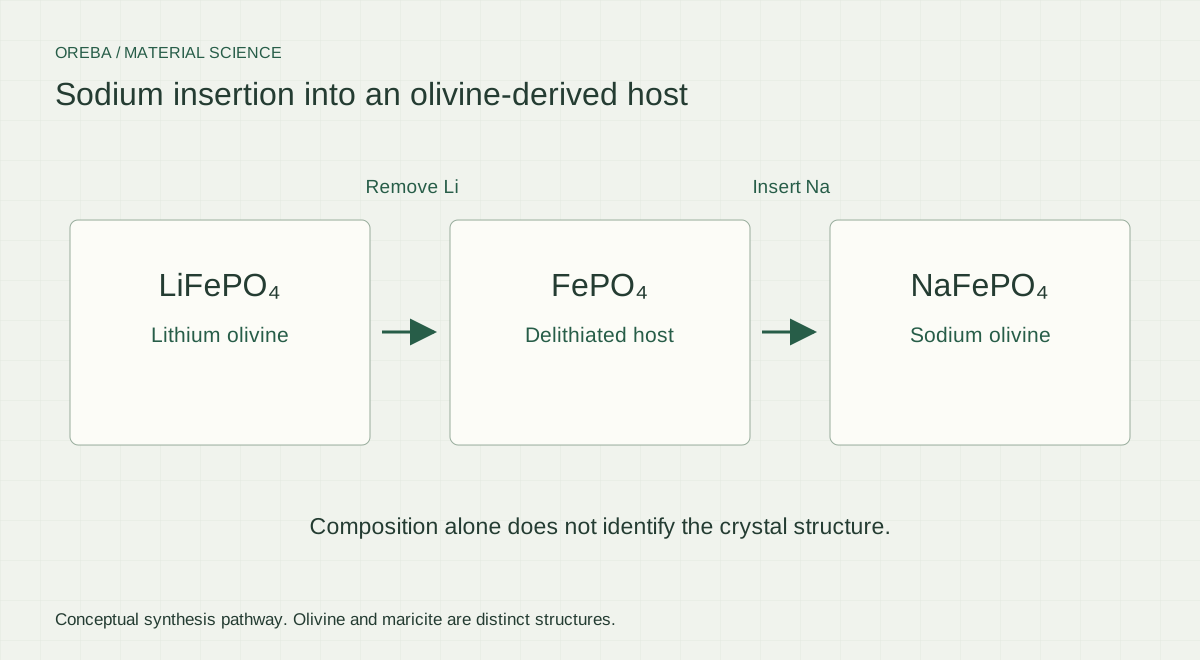
NaFePO₄ can describe different structural forms. An olivine-derived sodium phosphate and maricite NaFePO₄ should not be compared as if the same composition guaranteed the same arrangement of ions. The pathways and possible structural transformations depend on that arrangement.
Moreau and colleagues studied sodium-intercalated phases in olivine FePO₄. A later OREBA presentation by Galceran and colleagues examined sodium insertion and extraction using diffraction, including intermediate compositions. These records give a defined structural context for the sodium-phosphate work. [2] [4]
The sodium-olivine article explains why phase identity, starting material and preparation history belong beside an electrochemical result.
Interpreting activated maricite
Kim and colleagues reported sodium storage in nanosized maricite material and connected that behaviour to an amorphous iron-phosphate transformation product. The change during operation is part of the finding. It should not be rewritten as evidence that unchanged maricite has the transport channels of an olivine. [3]
This is also a general measurement lesson. Characterizing only the starting powder may miss the structure that later stores charge. An initial capacity, a reversible capacity after activation and a retained capacity after cycling answer different questions.
From a sodium compound to a sodium cell
The mass of sodium differs from that of lithium, as the CIAAW atomic-weight table records. With the same electron count, changing formula mass changes the theoretical gravimetric capacity. That calculation isolates stoichiometry; it does not establish the energy, cost or service life of a finished cell. [5]
Electrode loading, conductive fraction, negative-electrode capacity and electrolyte stability all remain relevant. A sodium-metal half-cell is useful for studying an electrode but has different balancing and interface constraints from a full cell. Any technology comparison must specify which configuration produced the result.
Historical material and current claims
Sodium-phosphate work appeared in the OREBA 1.0 programme. The presentation is preserved as a historical research source, rather than a current commercialization announcement. Statements about production scale or market adoption need a dated source beyond a conference programme.
The publications library links the sodium references used here. The lithium-ion reference provides the corresponding cell concepts, while the olivine reference introduces the framework shared by part of this research.
References
Research Development on Sodium-Ion Batteries. Chemical Reviews, 2014. DOI: 10.1021/cr500192f.
Publisher or institutional record ↗Structure and Stability of Sodium Intercalated Phases in Olivine FePO 4. Chemistry of Materials, 2010. DOI: 10.1021/cm101377h.
Publisher or institutional record ↗Unexpected discovery of low-cost maricite NaFePO 4 as a high-performance electrode for Na-ion batteries. Energy & Environmental Science, 2015. DOI: 10.1039/C4EE03215B.
Publisher or institutional record ↗Insights on the mechanism of Na Extraction/Insertion in NaFePO4/FePO4 cathode material. OREBA 1.0 presentation, Montreal, 26 May 2014, 2014.
Standard atomic weights. CIAAW / IUPAC, 2024.