
Olivine Cathodes
Why carbon coating matters in LiFePO₄ cathodes
How carbon connects LFP particles to an electrode’s electronic network, why coating quality matters and which transport limitations a coating cannot resolve.
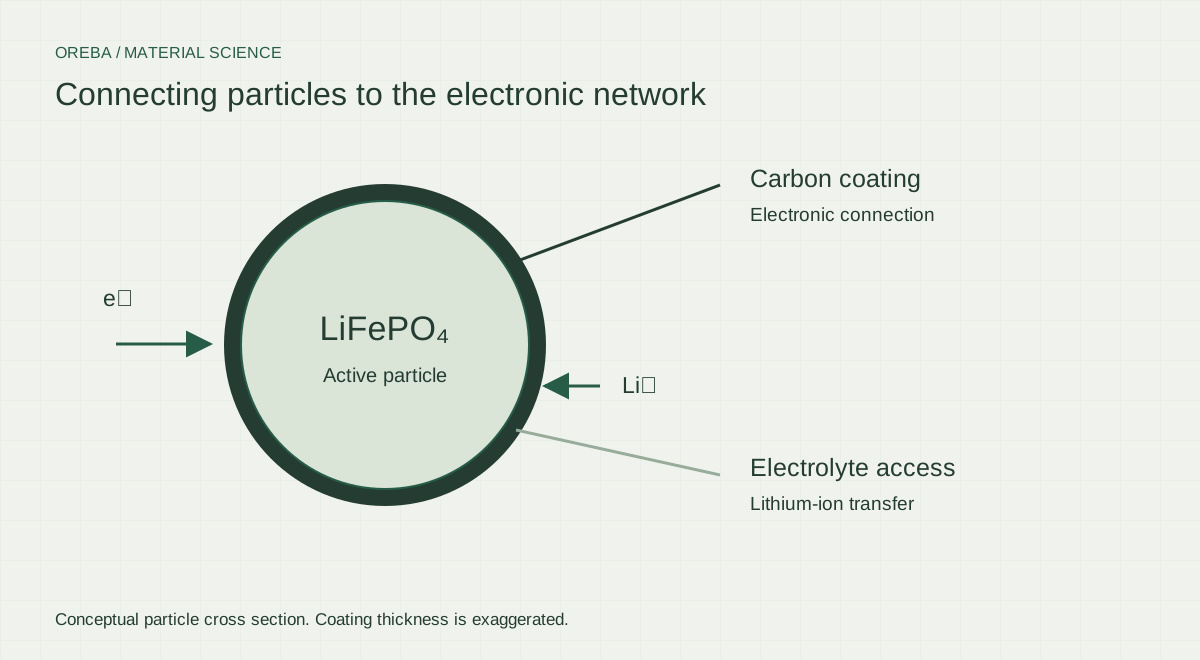
A working LiFePO₄ electrode needs a continuous route for electrons between the active material and the current collector. The low electronic conductivity of unmodified LFP makes this route difficult to establish with active particles alone. Carbon coatings and conductive additives form part of the electronic network used to access those particles. [3]
The carbon layer is an electrode-engineering measure. It does not supply the iron redox capacity, create a new phosphate crystal structure or remove the need for lithium-ion transport. The LFP chemistry reference describes the reaction that the network supports.
A coating and a network are different things
A particle coating distributes conducting material around an active particle. An electrode-wide network also needs connections between particles, conductive additives and the current collector. A well-coated particle can remain poorly used if it is electrically isolated from the rest of the electrode.
Conversely, adding a conducting powder does not demonstrate that every active particle has suitable contact. The distribution of carbon, particle agglomeration and the binder structure affect which connections survive drying and compression. An electrode formulation is therefore more than the total quantities in its mixing recipe. [3]
At the particle surface, ions must still transfer between the electrolyte and the active material. A design that improves electronic contact can also change that interfacial environment. The coating’s effectiveness needs evaluation in the complete composite rather than in isolation.
Carbon structure influences performance
Wilcox and colleagues prepared LFP/carbon composites and compared their conducting properties with electrochemical behaviour in lithium half-cells. Their work related carbon structural factors, including measures obtained from Raman spectroscopy and elemental analysis, to conductivity and rate behaviour. The conclusion is more specific than a simple rule that increasing carbon content always improves an electrode. [1]
An earlier study by Doeff and colleagues examined the effect of surface carbon structure on LFP electrochemical performance. Together, these studies provide experimental reasons to investigate the character of the carbon phase as well as its amount. [2]
Carbon precursors and thermal processing can affect the coating’s continuity, residual composition and particle growth. A synthesis comparison should report the resulting material properties. Using the same precursor name does not establish equivalent carbon structure in powders prepared under different conditions.
Thickness, coverage and inactive mass
An incomplete coating can leave weak electronic connections. A coating with excessive thickness or poorly accessible coverage can impede ion transfer and lower the active-material fraction. Modern olivine literature discusses coating uniformity and thickness together with the fabrication method. It does not supply a universal optimum for every particle morphology and electrode design. [3]
The mass denominator changes the apparent capacity. A value reported per gram of LiFePO₄ excludes the carbon mass; a value per gram of coated composite includes it. Neither should be compared directly with a complete-cell value without identifying the difference. The same issue applies to binder and additional conductive material in an electrode.
There is also a volume trade-off. Fine particles and conducting networks can improve access to the reaction, but the resulting packing and pore structure affect volumetric energy density. These quantities should be measured rather than inferred from a drawing of a uniformly coated sphere.
What carbon does not solve
Lithium still moves through the active material. Experimental work on LFP visualizes a strongly directional bulk pathway along [010]. A surface electronic coating does not, by itself, remove a blocked pathway or shorten the dimensions of the particle along that direction. [4]
Transport through the electrolyte-filled pores becomes a separate constraint in a thick electrode. Increasing electronic conductivity will not necessarily remove an ionic concentration gradient through that porous layer. Surface transfer, phase changes and the operating temperature can introduce additional limitations. The lithium-diffusion article explains why one observed rate response can contain several processes.
In a solid-state composite, carbon also creates interfaces with the solid electrolyte. Electronically accessible electrolyte surfaces can be sites of decomposition if the electrolyte is unstable at the applied potential. The requirements for electronic contact and chemical compatibility must therefore be considered together. [5]
Reading a coating study
A comparison is more informative when its materials and electrochemical conditions are matched. Relevant information includes the carbon amount and structure, evidence for surface coverage, particle dimensions, electrode loading, porosity, voltage limits, current and temperature.
Half-cell testing is useful for investigating the positive electrode. It does not capture every constraint of an LFP/graphite full cell or a solid-state battery. Results at a low active-material loading also need further evaluation before they are transferred to a dense practical electrode.
The question to ask is which resistance or access problem the coating changed. A better conducting network can raise the utilization of an existing redox material. Establishing that mechanism requires evidence about the network and the test, not only a higher capacity number.
References
Factors Influencing the Quality of Carbon Coatings on LiFePO4. Journal of The Electrochemical Society, 2007. DOI: 10.1149/1.2667591.
Publisher or institutional record ↗Effect of Surface Carbon Structure on the Electrochemical Performance of LiFePO4. Electrochemical and Solid-State Letters, 2003. DOI: 10.1149/1.1601372.
Publisher or institutional record ↗Unveiling olivine cathodes for high energy-density lithium-ion batteries: a comprehensive review from the atomic level to the electrode scale. Journal of Materials Chemistry A, 2024. DOI: 10.1039/D4TA02338B.
Publisher or institutional record ↗Experimental visualization of lithium diffusion in LixFePO4. Nature Materials, 2008. DOI: 10.1038/nmat2251.
Publisher or institutional record ↗Understanding interface stability in solid-state batteries. Nature Reviews Materials, 2020. DOI: 10.1038/s41578-019-0157-5.
Publisher or institutional record ↗