
Olivine Cathodes
Lithium diffusion in LiFePO₄: pathways, defects and rate capability
Separate directional lithium motion in LFP crystals from apparent electrode transport, and examine how defects, particle shape and test methods affect rate behaviour.
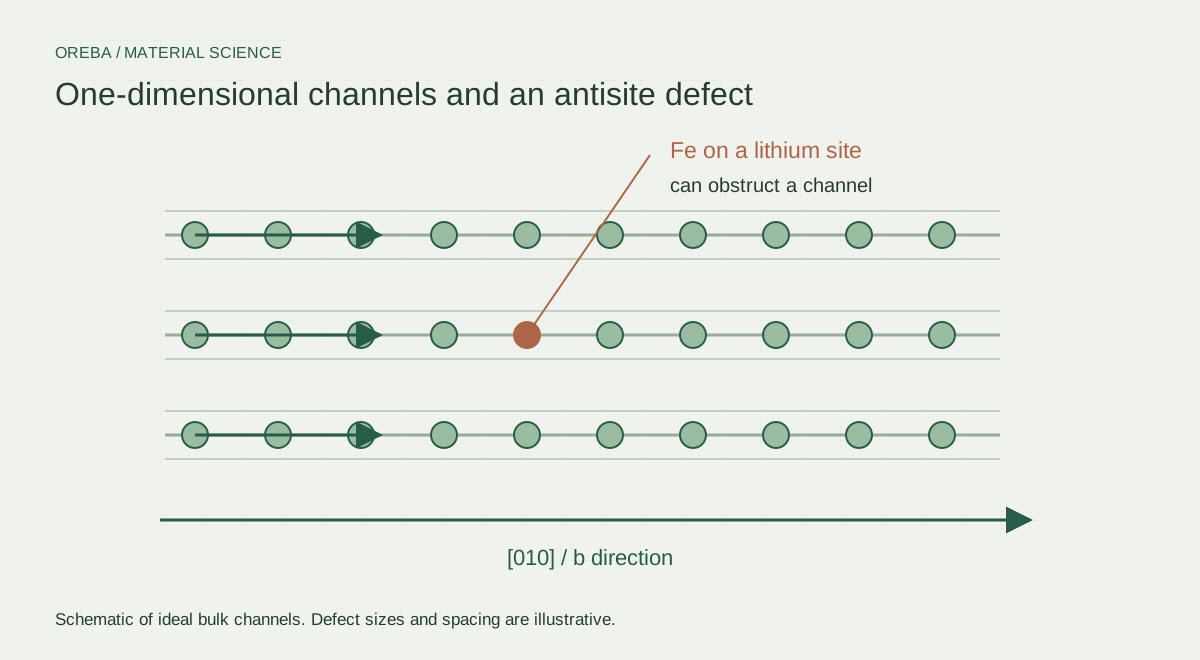
Lithium diffusion in LiFePO₄ is a directional material process. The rate capability of an LFP electrode is a combined electrochemical response. The two are related, but a discharge at a high current does not isolate diffusion inside the crystal from electronic resistance, electrolyte transport, surface transfer or phase-change kinetics.
Experimental visualization of lithium motion provides an anchor for the structural picture. Nishimura and colleagues used high-temperature neutron diffraction with maximum-entropy analysis to obtain evidence for a curved one-dimensional lithium pathway along [010]. This identifies a preferred bulk direction, not a single transport value that applies to every LFP electrode. [1]
A directional pathway through the host
In the olivine framework, the arrangement of lithium sites makes migration along the b direction different from migration across other crystallographic directions. Computational studies of olivine conductivity and atomistic defects investigated this transport problem before the experimental visualization. [2] [3]
The geometry gives a physical reason to specify particle shape. A thin dimension along a relevant transport direction can provide a short path even when another dimension is much larger. Surface accessibility and crystallographic orientation are therefore more informative than a single diameter where the particles are anisotropic.
Powder labels also need care. Primary crystallites can be assembled into larger secondary particles or agglomerates. A reported size may refer to different objects depending on whether it was obtained by imaging, diffraction analysis or a particle-size instrument. A diffusion-length argument must identify which object supplies the length.
Defects and channel access
An antisite defect involves a cation occupying a site normally assigned to another cation. In LFP, iron on a lithium site is relevant because it can obstruct a preferred lithium pathway. The modern olivine review discusses this connection between one-dimensional motion and defect sensitivity. [4]
The effect in a real particle depends on defect distribution, channel length and available surfaces. A schematic with one blocked channel does not prove how much capacity a particular powder loses. That quantitative conclusion requires measurements or a specified model of the actual material.
Defect control is also not equivalent to adding a dopant. A dopant changes local chemistry and can affect more than one property. Evidence for incorporation, phase purity and the resulting electrochemical response is needed before a performance change is assigned to improved intrinsic transport.
The diffusion-length estimate
A simple diffusion timescale is:
Here is a characteristic diffusion distance, is a diffusion coefficient in consistent length units squared per time, and is a time. The scaling follows from a diffusion equation for a homogeneous medium with a fixed coefficient and comparable boundary conditions. It is an explanatory approximation, not a complete model of a phase-transforming porous electrode.
Within those assumptions, reducing by a factor of ten reduces the estimated timescale by a factor of one hundred. This is a calculated ratio, obtained by squaring the assumed length ratio. It does not predict that a smaller LFP powder will deliver one hundred times the current. Electronic contact, surface transfer and the electrode pore network remain in the reaction path.
Diffusion coefficients describe different quantities
A microscopic hopping model, a tracer measurement and an electrochemical fit can yield transport quantities with different meanings. Chemical transport responds to composition gradients and thermodynamics as well as microscopic mobility. The state of lithiation, temperature and assumed model must accompany any quoted coefficient.
Electrochemical methods such as intermittent titration or impedance analysis infer parameters from a model applied to measured signals. If the model represents an electrode as a simpler geometry than the actual porous composite, the fitted quantity can include effects that are not purely bulk diffusion. Apparent values should therefore be compared with their methods and assumptions intact.
LFP phase behaviour adds another complication. The reaction under applied current may differ from a simple equilibrium picture, as examined in work on non-equilibrium lithium incorporation. A measurement near a phase transformation should not automatically be interpreted using the assumptions of a uniform single-phase solid. [5]
For these reasons, this reference does not supply one “correct LFP diffusion coefficient.” The evidence supports a directional transport picture; a numerical transport parameter belongs to a defined material state and measurement.
From the particle to the electrode
Carbon improves electronic connections, while the electrolyte carries ions through the porous electrode. Changing either network can alter measured rate behaviour even when the bulk lithium pathway remains unchanged. LFP/carbon composite experiments illustrate how carbon characteristics affect conducting and electrochemical properties. [6]
The carbon-coating article addresses the electronic network. The structure article addresses phase behaviour and the host framework. Reading them together helps avoid assigning every high-rate limitation to diffusion.
A convincing claim of improved lithium transport needs a specific chain of evidence: a defined structural or particle change, a method that measures a relevant transport quantity, and an electrode comparison under stated conditions. A capacity increase alone demonstrates a changed response, but does not identify its cause.
References
Experimental visualization of lithium diffusion in LixFePO4. Nature Materials, 2008. DOI: 10.1038/nmat2251.
Publisher or institutional record ↗Atomic-Scale Investigation of Defects, Dopants, and Lithium Transport in the LiFePO4 Olivine-Type Battery Material. Chemistry of Materials, 2005. DOI: 10.1021/cm050999v.
Publisher or institutional record ↗Li Conductivity in LixMPO4 (M = Mn, Fe, Co, Ni) Olivine Materials. Electrochemical and Solid-State Letters, 2004. DOI: 10.1149/1.1633511.
Publisher or institutional record ↗Unveiling olivine cathodes for high energy-density lithium-ion batteries: a comprehensive review from the atomic level to the electrode scale. Journal of Materials Chemistry A, 2024. DOI: 10.1039/D4TA02338B.
Publisher or institutional record ↗Kinetics of non-equilibrium lithium incorporation in LiFePO4. Nature Materials, 2011. DOI: 10.1038/nmat3065.
Publisher or institutional record ↗Factors Influencing the Quality of Carbon Coatings on LiFePO4. Journal of The Electrochemical Society, 2007. DOI: 10.1149/1.2667591.
Publisher or institutional record ↗