
Emerging Chemistries
Sodium-ion olivine cathodes: NaFePO₄ and related materials
Why NaFePO4 composition does not identify a crystal structure, how olivine-derived sodium hosts are studied and what maricite results actually establish.
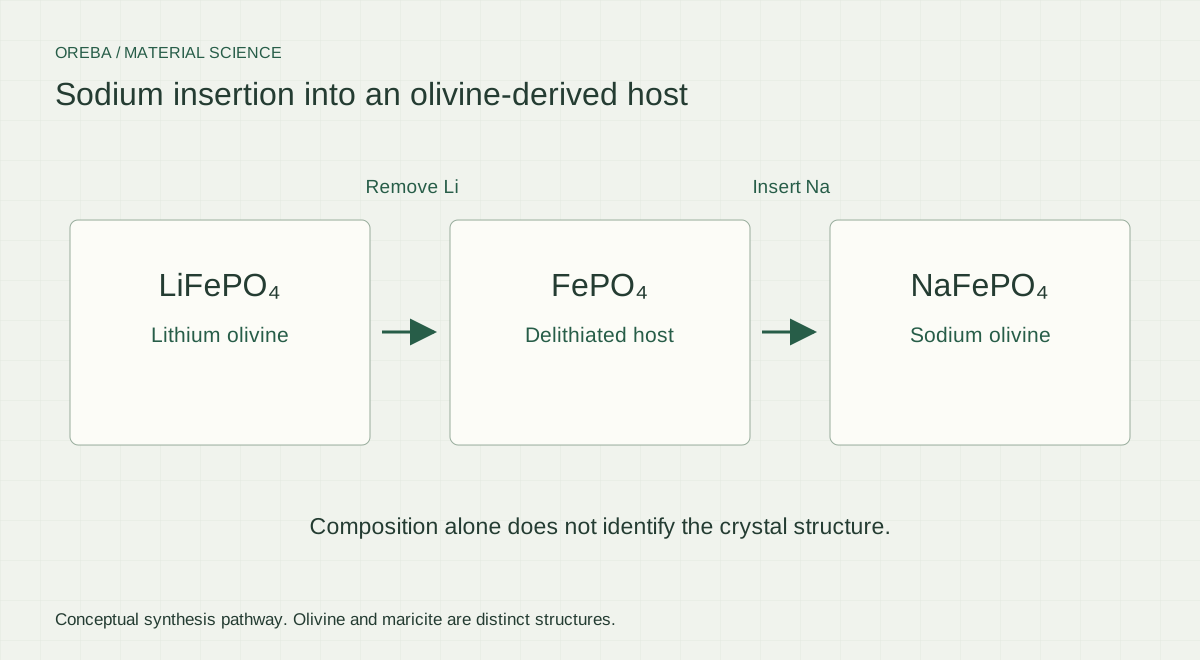
NaFePO₄ names a composition. It does not, by itself, identify the arrangement of sodium, iron and phosphate in a sample. Olivine-derived and maricite structures have different cation arrangements and transport behaviour. Their electrochemical results should be described with the phase identity and processing route intact.
Sodium iron phosphate connects directly with the historical OREBA subject matter. The 2014 programme included a presentation on sodium extraction and insertion in NaFePO₄/FePO₄, and poster material addressed sodium-containing iron phosphate. These records establish that sodium systems were part of the conference discussion. [4] [5]
Moving sodium into an olivine-derived host
One research route starts with the lithium phosphate framework, removes lithium and introduces sodium into a related iron-phosphate host. Structural characterization is needed to establish what happens during the exchange. The starting material’s identity does not guarantee the final product’s structure.
Moreau and colleagues investigated sodium-intercalated phases in olivine FePO₄. The historical OREBA presentation discusses sodium insertion and extraction and distinguishes the resulting phases. This provides a specific research context for olivine-derived sodium phosphate, rather than a claim that every NaFePO₄ synthesis produces the same phase. [1] [5]
Ion exchange changes more than the identity of the mobile ion. Occupancy, lattice response and intermediate compositions can differ. The sodium system needs its own structural and electrochemical measurements; substituting “Na” into an LFP description is not sufficient.
Why the maricite result needs its own explanation
Maricite NaFePO₄ has often been discussed as a poor starting framework for straightforward sodium transport. Kim and colleagues reported electrochemical activity in nanosized maricite and explained it through a transformation to an amorphous iron-phosphate phase during sodium removal. The transformed structure was part of the reported mechanism. [2]
That result should not be shortened to “maricite has the same transport channels as olivine.” It also does not demonstrate equivalent performance in a conventional large-particle maricite powder. Particle processing and structural transformation are essential to interpreting the experiment.
An amorphous transformation product is not described by the same long-range periodic order as the starting crystal. A diffraction pattern of the initial powder therefore does not establish the structure that stores charge after electrochemical activation. Characterizing the operating or recovered material addresses a different question.
Charge capacity and the mass of sodium
Replacing lithium with sodium changes molar mass. Sodium’s standard atomic weight is larger than lithium’s, as recorded by CIAAW. For a comparable one-electron-per-formula-unit calculation, the added molar mass changes the gravimetric capacity. This is a stoichiometric consequence, not a complete comparison between lithium-ion and sodium-ion cells. [6]
The capacity calculation uses with in grams per mole. The same relationship is derived in the LFP chemistry article. The electron count, formula mass and mass denominator must be stated for any material comparison.
Measured reversible capacity additionally depends on phase accessibility, voltage limits and the electrode formulation. A first discharge capacity can contain processes that are not recovered on subsequent cycles. A comparison needs to distinguish initial, reversible and retained capacity.
Sodium-ion batteries contain other material choices
Sodium-ion research includes oxide and polyanionic positive electrodes, together with compatible negative electrodes and electrolytes. A sodium olivine is one research direction within this broader set. The review by Yabuuchi and colleagues provides historical technical context for sodium-ion materials development. [3]
The negative electrode, electrolyte and cell balancing affect the finished battery’s voltage and usable energy. The cathode formula alone cannot establish cost, safety or service life. The sodium-ion reference introduces the operating principle and keeps those cell-level questions separate from a specific phosphate experiment.
Raw-material availability is also distinct from measured cell performance. A material may use abundant elements and still require a demanding processing route. Claims about manufacturing economics need a defined process, production scale and dated evidence.
What to check in a sodium-phosphate study
The synthesis route should identify the initial material, exchange or activation steps and final composition. Phase evidence should state whether the electrode remains crystalline, contains mixed phases or transforms during cycling. The electrochemical protocol should identify the sodium counter or negative electrode and whether the result comes from a half-cell or full cell.
Electrode loading, conductive fraction, electrolyte, rate and temperature belong alongside the reported capacity. A structural claim and a performance claim need evidence for each link between them. This makes sodium-phosphate results comparable without flattening distinct compounds and transformed phases into one chemistry label.
References
Structure and Stability of Sodium Intercalated Phases in Olivine FePO 4. Chemistry of Materials, 2010. DOI: 10.1021/cm101377h.
Publisher or institutional record ↗Unexpected discovery of low-cost maricite NaFePO 4 as a high-performance electrode for Na-ion batteries. Energy & Environmental Science, 2015. DOI: 10.1039/C4EE03215B.
Publisher or institutional record ↗Research Development on Sodium-Ion Batteries. Chemical Reviews, 2014. DOI: 10.1021/cr500192f.
Publisher or institutional record ↗OREBA 1.0: conference programme. OREBA 1.0 organizers, 2014.
Insights on the mechanism of Na Extraction/Insertion in NaFePO4/FePO4 cathode material. OREBA 1.0 presentation, Montreal, 26 May 2014, 2014.
Standard atomic weights. CIAAW / IUPAC, 2024.