
Battery Materials
LiFePO₄ batteries: chemistry, structure, performance and limits
How iron redox, olivine structure and electrode engineering determine LFP voltage, capacity, transport and stability, with clear material-to-cell distinctions.
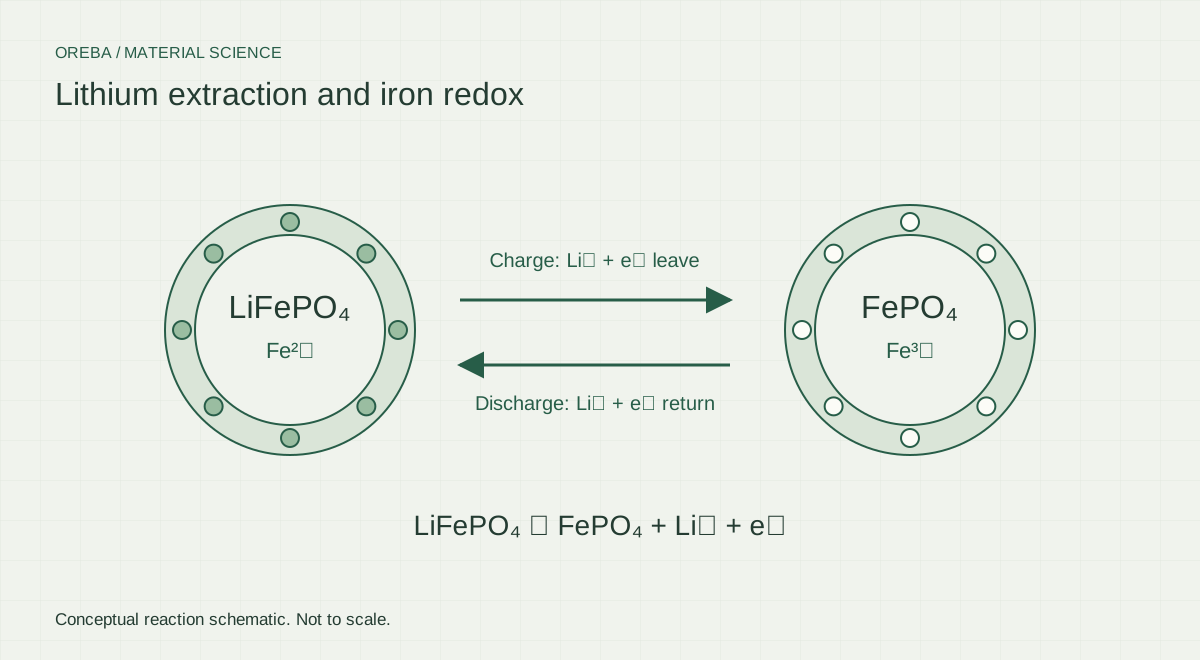
Lithium iron phosphate, LiFePO₄ or LFP, is a positive-electrode material for rechargeable lithium-ion batteries. Its reversible reaction exchanges lithium with the rest of the cell while changing the oxidation state of iron. Padhi, Nanjundaswamy and Goodenough described phospho-olivines as battery positive electrodes in 1997. The subsequent engineering of particles and electrodes made the chemistry useful beyond that initial material study. [1] [2]
An LFP battery still needs a negative electrode, electrolyte, separator, current collectors and enclosure. Calling a cell “LFP” identifies its cathode chemistry; it does not specify its complete construction or operating limits. The lithium-ion reference explains how these components work together.
The reaction that stores charge
During charge, lithium leaves the LFP positive electrode. Iron is oxidized from Fe²⁺ toward Fe³⁺, with the corresponding electron removed through the external circuit. Lithium ions move through the electrolyte to the negative electrode. During discharge the process reverses. For the idealized end members, the positive-electrode reaction is:
The equation is a stoichiometric description. It does not specify the spatial sequence of reactions within an electrode or the distribution of lithium between particles. The equilibrium phase behaviour and the reaction under applied current need separate treatment. [1] [2]
The phosphate framework retains the basic host architecture as lithium is exchanged. The PO₄ groups contain strongly bonded phosphorus and oxygen, while lithium and iron occupy different sites in the olivine structure. This chemical arrangement contributes to LFP’s structural and thermal behaviour, but also constrains ion and electron transport. [2]
Voltage and capacity are different properties
The iron redox reaction produces a working potential around 3.4 V versus Li/Li⁺, as discussed in the 2024 olivine review. This is an electrode potential relative to lithium metal. A graphite/LFP full-cell voltage is the difference between the positive- and negative-electrode potentials and changes with operating conditions. A cathode plateau should therefore not be copied into a full-cell specification without that distinction. [2]
Specific capacity measures how much charge can be exchanged per mass. Assuming one reversible electron per LiFePO₄ formula unit, the theoretical capacity is calculated from:
Here is the assumed electron count, is the Faraday constant and is the molar mass of LFP. The factor 3.6 converts coulombs to milliampere-hours. The result is approximately 170 mAh g⁻¹ of active LiFePO₄, an original stoichiometric calculation using NIST constants and rounded atomic weights consistent with CIAAW data. This value assumes complete reversible utilization; it is not a measured commercial-cell capacity. [6] [7]
Carbon, binder, current collectors and the other cell components add mass without providing the same LFP redox capacity. Practical specific capacity also depends on how much active material remains accessible within the chosen voltage limits and test rate. Reporting a capacity requires identifying the mass denominator.
Ion transport inside the particle
Lithium motion in the ideal bulk olivine framework is strongly directional. Nishimura and colleagues used neutron diffraction and maximum-entropy analysis to visualize a curved one-dimensional lithium distribution along [010], the crystallographic b direction. Their result provides experimental support for the transport geometry; it does not establish a universal diffusion coefficient for every LFP powder or state of charge. [3]
Particle dimensions along a transport direction affect the distance lithium must travel. Defects, surface reactions and phase changes affect access to that pathway. Making a particle smaller can shorten transport distances, while also changing surface area, packing and the amount of inactive material needed in an electrode. These effects must be considered together. The lithium-diffusion article separates bulk transport from the measurements made on complete electrodes.
Building an electronic network
The low electronic conductivity of unmodified LFP makes electrical contact an electrode-design problem. Carbon coatings and conductive additives connect particles to one another and to the current collector. A coating on an isolated particle is only one part of that network. [2]
Wilcox and colleagues investigated LFP/carbon composites and found that carbon structural characteristics influenced conductivity and half-cell rate behaviour. Their work gives a reason to examine carbon quality and distribution, rather than treating carbon mass fraction as a complete performance descriptor. [4]
Thick electrodes introduce additional transport distances through the electrolyte-filled pore network and the electronic network. A powder with good low-loading laboratory results can behave differently when used at a practical areal loading. The carbon-coating article examines these distinctions.
Stability, ageing and application limits
LFP’s phosphate framework is relevant to cathode stability. Complete-cell safety also depends on electrolyte reactivity, the negative electrode, internal short circuits, temperature control and protective systems. Stability in one electrolyte or at one temperature cannot be transferred to all cell conditions. [8]
An LFP/graphite cell can lose usable capacity through reactions at the graphite electrode even when its positive-electrode framework remains comparatively stable. Lithium inventory loss, changes in interfaces and rising transport resistance must therefore be evaluated at cell level. The degradation reference distinguishes these mechanisms. [5]
LFP’s capacity and electrode voltage set part of its energy-density limit. Packaging, electrode loading, porosity and the usable state-of-charge range determine how much of that material-level potential appears in a finished product. Stationary storage and electric vehicles impose different requirements on mass, volume, power and service life. A chemistry comparison becomes useful when those requirements and the measurement boundaries are stated explicitly.
References
Phospho‐olivines as Positive‐Electrode Materials for Rechargeable Lithium Batteries. Journal of The Electrochemical Society, 1997. DOI: 10.1149/1.1837571.
Publisher or institutional record ↗Unveiling olivine cathodes for high energy-density lithium-ion batteries: a comprehensive review from the atomic level to the electrode scale. Journal of Materials Chemistry A, 2024. DOI: 10.1039/D4TA02338B.
Publisher or institutional record ↗Experimental visualization of lithium diffusion in LixFePO4. Nature Materials, 2008. DOI: 10.1038/nmat2251.
Publisher or institutional record ↗Factors Influencing the Quality of Carbon Coatings on LiFePO4. Journal of The Electrochemical Society, 2007. DOI: 10.1149/1.2667591.
Publisher or institutional record ↗Lithium ion battery degradation: what you need to know. Physical Chemistry Chemical Physics, 2021. DOI: 10.1039/D1CP00359C.
Publisher or institutional record ↗2022 CODATA value: Faraday constant. NIST, 2022.
Standard atomic weights. CIAAW / IUPAC, 2024.
On the Stability of LiFePO4 Olivine Cathodes under Various Conditions (Electrolyte Solutions, Temperatures). Electrochemical and Solid-State Letters, 2007. DOI: 10.1149/1.2403974.
Publisher or institutional record ↗