
Degradation & Safety
Battery degradation
A battery-ageing reference that distinguishes lithium inventory, active-material loss and resistance growth, with practical guidance for reading LFP life tests.
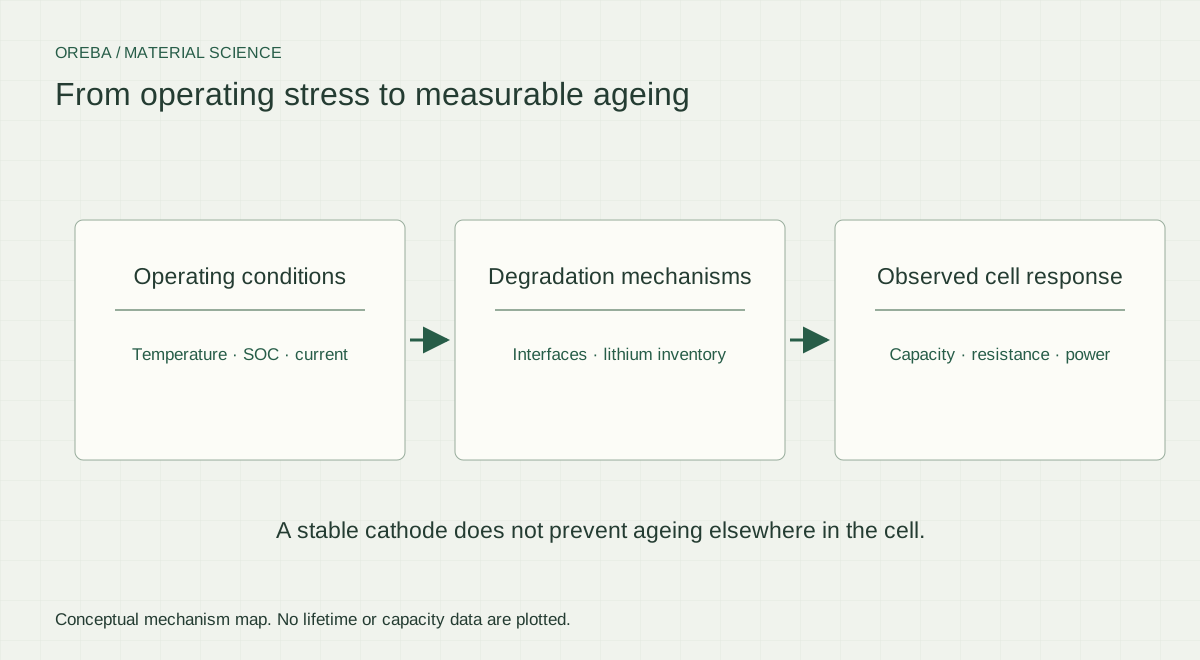
Battery ageing changes the charge, energy or power a cell can deliver under defined conditions. A capacity test records an outcome. To explain it, the underlying reactions and physical changes need to be distinguished from the quantities that the test measures.
Edge and colleagues organize lithium-ion degradation through interacting mechanisms and observable modes, including loss of lithium inventory, loss of active material and increasing resistance. One measured symptom can have several causes. [1]
Capacity, energy and power can age differently
Loss of cyclable lithium limits the amount available to shuttle between electrodes. Loss of active material reduces the accessible storage sites. Higher resistance increases polarization and can make a voltage cutoff arrive sooner during a high-current discharge.
Consequently, two cells with similar low-rate capacity may deliver different power or energy at the intended duty. Reporting only retained capacity can hide this difference. A useful life test states the reference-test rate, temperature and voltage limits as well as its ageing protocol.
The LFP degradation article examines these distinctions in graphite/LFP cells. Its capacity-retention equation defines the initial reference and the later measurement, rather than assigning a universal end-of-life threshold.
Calendar ageing and cycle ageing
Calendar ageing concerns changes with elapsed time, including periods without cycling. State of charge and temperature remain relevant during storage. Cycle ageing concerns the effect of repeated operation, with current, depth of discharge, voltage limits and charging protocol among the necessary conditions.
Naumann and colleagues studied calendar ageing of a commercial LFP/graphite cell. Wang and colleagues developed a cycle-life model for graphite/LFP cells. These are different study designs, and their parameters should remain attached to the cells and conditions that produced them. [3] [4]
A duty containing both storage and repeated cycling may involve interactions between mechanisms. Adding two independently fitted losses is an assumption that requires validation; the labels alone do not prove independence.
Why LFP cells still degrade
An LFP positive electrode does not remove the negative-electrode interface or the cell’s finite lithium inventory. A graphite/LFP cell can experience interphase growth and, under unsuitable charging conditions, lithium plating. These processes occur in a cell whose positive material may remain comparatively stable. [1]
Safari and Delacourt’s commercial-cell study examined storage and cycling at specified temperatures. It illustrates why “LFP lasts a given number of cycles” is incomplete without the cell identity and protocol. [2]
Interpreting a service-life claim
Check whether the endpoint is capacity, energy, resistance or a safety condition. Specify the reference test and whether replacement is governed by cell or system performance. Report elapsed time alongside cycles, and explain the extrapolation used for any forecast.
The energy-storage reference connects ageing to delivered system duty. Definitions of state of health, state of charge and C-rate help make different protocols comparable.
References
Lithium ion battery degradation: what you need to know. Physical Chemistry Chemical Physics, 2021. DOI: 10.1039/D1CP00359C.
Publisher or institutional record ↗Aging of a Commercial Graphite/LiFePO4 Cell. Journal of The Electrochemical Society, 2011. DOI: 10.1149/1.3614529.
Publisher or institutional record ↗Analysis and modeling of calendar aging of a commercial LiFePO4/graphite cell. Journal of Energy Storage, 2018. DOI: 10.1016/j.est.2018.01.019.
Publisher or institutional record ↗Cycle-life model for graphite-LiFePO4 cells. Journal of Power Sources, 2011. DOI: 10.1016/j.jpowsour.2010.11.134.
Publisher or institutional record ↗