
Emerging Chemistries
Solid-state batteries
A reference for solid-state battery research covering electrolyte transport, electrode contact, interphase chemistry and meaningful cell-level comparisons.
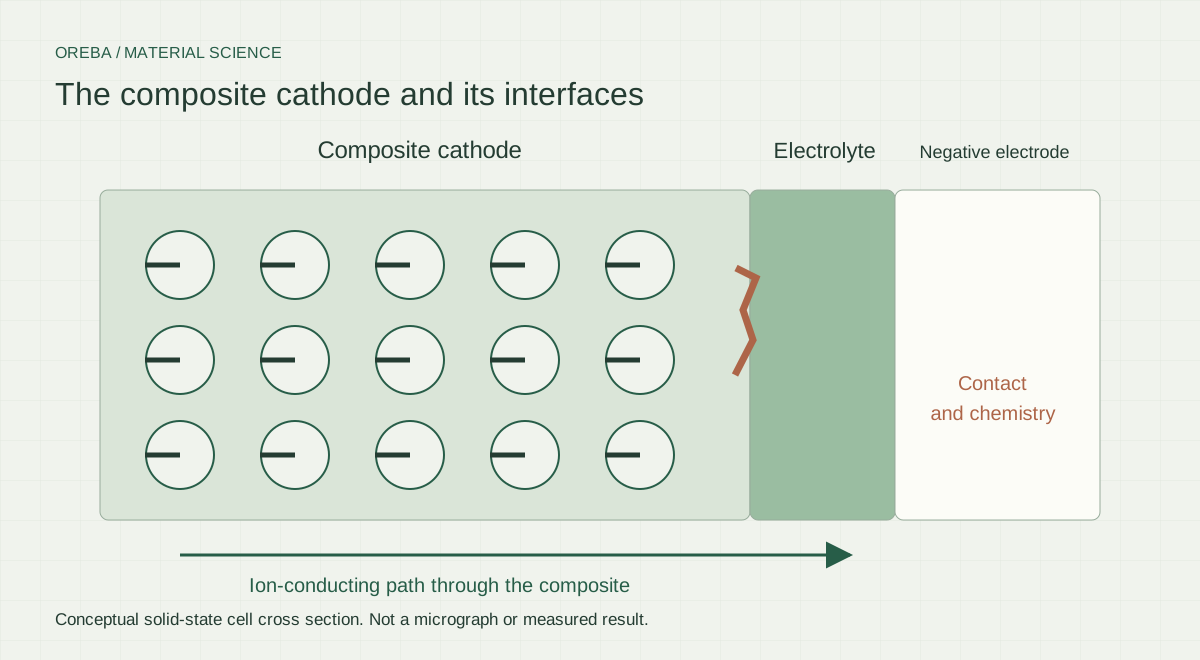
Solid-state battery research replaces liquid electrolyte pathways with a solid ion-conducting material in some or all of the cell. The exact architecture must be specified: a composite electrode, a polymer-containing design and an all-solid-state inorganic cell can have different transport and processing requirements.
The central questions include ionic conductivity, electrode contact, chemical compatibility and mechanical response during cycling. Xiao and colleagues’ interface review treats these requirements together rather than reducing the problem to electrolyte conductivity alone. [1]
Bulk conduction and usable contact
Conductivity measured in a dense electrolyte sample characterizes transport through that sample. A working composite cathode also needs connected paths to active particles and electronic access to the current collector. Poor contact or isolated particles can limit utilization even when the electrolyte has suitable bulk conductivity.
Pressure, particle arrangement and processing conditions influence contact. Pressure is therefore part of the cell specification, alongside temperature, current, loading and thickness. A result requiring substantial external pressure needs that condition retained when discussing practical performance.
An interphase can help or hinder
At an electrode–electrolyte contact, thermodynamic instability may drive decomposition. Whether the resulting interphase blocks further reaction depends on its transport properties and structure. An electronically insulating layer that still permits ionic transport differs from a mixed conductor that allows continued reaction. [1]
For an olivine composite, the conductive carbon is another surface contacting the solid electrolyte. Carbon treatment cannot be judged only by an LFP/liquid-electrolyte test. The entire composite and its operating potential need to be considered.
The olivine and solid-state article follows these paths through the positive electrode. The carbon-coating article establishes the electronic-network question that precedes interface compatibility.
Lithium metal does not remove failure mechanisms
A lithium-metal negative electrode is one possible design choice, rather than a necessary definition of every solid-state battery. Where lithium metal is used, infiltration and shorting remain research concerns. Porz and colleagues studied penetration at defects in inorganic solid electrolytes under applied current. Their work rules out a simple inference that a stiff solid automatically prevents lithium penetration. [2]
Safety claims need a defined cell, electrolyte and test. The absence of a conventional liquid solvent does not establish safe behaviour under every electrical, thermal or mechanical condition.
Comparing complete designs
Randau and colleagues’ benchmarking paper provides a reference for practical comparisons of all-solid-state lithium batteries. Read energy claims with their electrode loading, electrolyte thickness, operating conditions and component masses intact. [3]
The OREBA III programme included olivine-based solid-state topics in 2025. Those titles document the subjects discussed; they do not establish a particular cell’s performance. [4] The energy-storage reference continues to the requirements imposed by a real operating duty.
References
Understanding interface stability in solid-state batteries. Nature Reviews Materials, 2020. DOI: 10.1038/s41578-019-0157-5.
Publisher or institutional record ↗Mechanism of Lithium Metal Penetration through Inorganic Solid Electrolytes. Advanced Energy Materials, 2017. DOI: 10.1002/aenm.201701003.
Publisher or institutional record ↗Benchmarking the performance of all-solid-state lithium batteries. Nature Energy, 2020. DOI: 10.1038/s41560-020-0565-1.
Publisher or institutional record ↗OREBA III: conference agenda. OREBA3, 2025.