
Cathode Chemistry
Lithium iron phosphate: LiFePO₄
An LFP reference covering iron phosphate chemistry, theoretical capacity, lithium pathways, conductive composites and the factors behind practical cell performance.
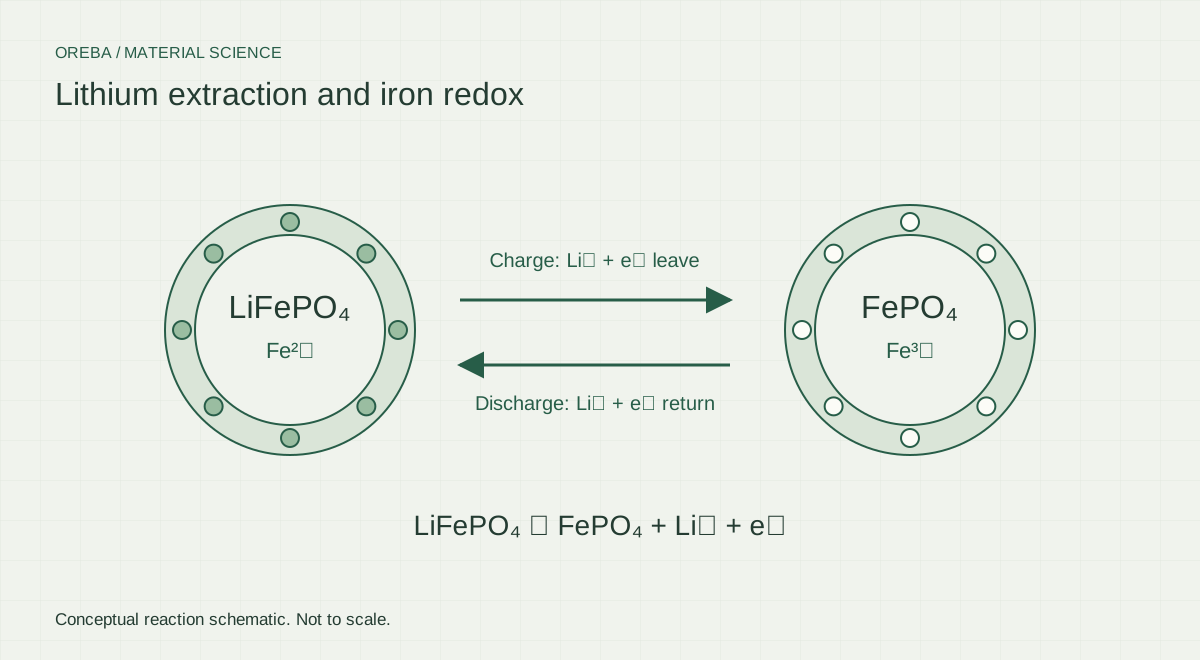
LFP is lithium iron phosphate, LiFePO₄, an olivine positive-electrode material. Charging removes lithium from the host and oxidizes iron; discharge reverses that process within the usable composition range. The foundational phospho-olivine paper was published by Padhi, Nanjundaswamy and Goodenough in 1997. [1]
The formula names the active material. A commercial LFP battery also contains a negative electrode, electrolyte, separator, current collectors, enclosure and controls. This distinction explains why material properties alone cannot specify cell energy or lifetime.
Three quantities that need separate definitions
The theoretical one-electron capacity is approximately 170 mAh g⁻¹ of LiFePO₄. The chemistry article derives this value from the Faraday constant and formula mass. It assumes complete access to one lithium per formula unit.
The iron redox plateau is commonly described at approximately 3.4 V versus Li⁺/Li. This is an electrode potential referenced to lithium metal. A complete cell’s voltage also depends on its negative electrode and polarization. The recent olivine review discusses the chemistry and the engineering constraints around these quantities. [2]
Usable cell energy combines delivered charge and voltage over a specified discharge. Its mass denominator includes components that the active-material capacity excludes. These three quantities should not be substituted for one another.
Transport and conductive design
Lithium transport is directional within the olivine framework. Electronic conduction requires an effective composite structure around and between particles. Carbon coatings and added conductive networks address electronic access; particle shape, defects and electrolyte access affect ionic transport. These are different parts of the same working electrode. [2]
For a reading sequence, start with the olivine framework, then examine lithium diffusion and carbon-coating design. The LMFP comparison explains why replacing part of the iron with manganese changes more than the average voltage.
Stability and service life
A stable phosphate host does not eliminate cell ageing. Graphite/LFP cells can lose cyclable lithium, develop resistance and experience negative-electrode degradation. Edge and colleagues distinguish degradation mechanisms from their observable effects on capacity and power. [3]
Safari and Delacourt studied a specified commercial graphite/LFP cell under storage and cycling conditions at different temperatures. Their experiment is evidence about that cell and protocol, rather than a universal LFP cycle-life figure. [4]
The degradation reference organizes calendar ageing, cycle ageing and measurement conditions. The energy-storage reference extends the discussion to system duty, efficiency and delivered energy.
What an LFP specification should include
To interpret performance, identify the electrode loading and composition, negative electrode, electrolyte, temperature, rate, voltage limits and end-of-life definition. Separate initial capacity from retained capacity and distinguish energy performance from a power test. A chemistry label is a useful starting point; these conditions make a battery result meaningful.
References
Phospho‐olivines as Positive‐Electrode Materials for Rechargeable Lithium Batteries. Journal of The Electrochemical Society, 1997. DOI: 10.1149/1.1837571.
Publisher or institutional record ↗Unveiling olivine cathodes for high energy-density lithium-ion batteries: a comprehensive review from the atomic level to the electrode scale. Journal of Materials Chemistry A, 2024. DOI: 10.1039/D4TA02338B.
Publisher or institutional record ↗Lithium ion battery degradation: what you need to know. Physical Chemistry Chemical Physics, 2021. DOI: 10.1039/D1CP00359C.
Publisher or institutional record ↗Aging of a Commercial Graphite/LiFePO4 Cell. Journal of The Electrochemical Society, 2011. DOI: 10.1149/1.3614529.
Publisher or institutional record ↗