
Cell Fundamentals
Lithium-ion batteries
How lithium-ion battery electrodes, electrolytes and interfaces work together, with a reading path through LFP chemistry, transport and cell degradation.
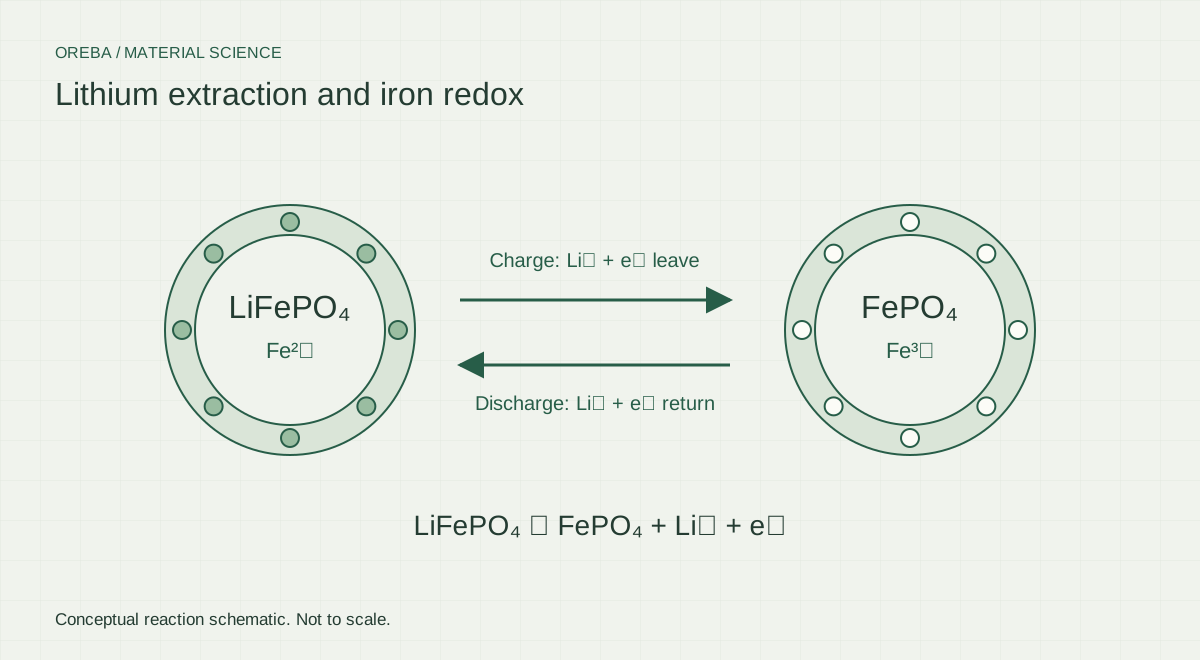
A lithium-ion cell stores energy through reversible reactions at two electrodes. During charge, an external power supply drives lithium toward the negative electrode while electrons move through the external circuit. Discharge delivers electrical work as the reactions proceed in the opposite direction.
The 2019 Nobel Prize in Chemistry recognized M. Stanley Whittingham, John B. Goodenough and Akira Yoshino for the development of lithium-ion batteries. That historical recognition concerns several contributions to a working rechargeable technology, rather than a single cathode formula. [1]
Components and their jobs
The positive electrode sets one side of the cell’s electrochemical potential. The negative electrode sets the other and must accommodate the corresponding lithium inventory. The electrolyte carries ions between them; electronic conduction through the external circuit supplies or delivers current. A separator prevents direct electrode contact while permitting ionic transport.
Current collectors gather electronic current. Pores, binders and conductive additives help turn active particles into a usable electrode. Those components consume mass and volume, so a complete-cell energy figure differs from the theoretical capacity of an active powder.
LFP is one positive-electrode choice. Its chemistry, structure and conductive requirements are treated in the LFP reference and the olivine-cathode reference. The olivine review connects material design to the behaviour of practical electrodes. [2]
Electrode potential and cell voltage
Cell voltage depends on the potential difference between the electrodes and on losses during current flow. A cathode potential reported versus Li⁺/Li uses a lithium-metal reference. It cannot simply be assigned to a cell with a different negative electrode.
Delivered energy requires the voltage profile and charge delivered within specified cutoffs. A nominal voltage is useful for a specification, but it does not reproduce the full discharge profile. Temperature, rate and ageing may change that profile.
The glossary distinguishes capacity from energy. The energy-storage page explains why those distinctions also matter when cells are assembled into modules and systems.
Interfaces make a cell more than its powders
Reactions at electrode–electrolyte interfaces can consume cyclable lithium or increase resistance. On a graphite negative electrode, the solid-electrolyte interphase has a protective role but can also grow during ageing. Under unsuitable charging conditions, lithium plating introduces another failure mechanism. Edge and colleagues review how these mechanisms interact. [3]
This connects a materials question to the operating protocol. A positive-electrode half-cell with lithium metal does not reproduce all the inventory constraints or negative-electrode behaviour of a graphite full cell. Testing one component is useful, provided the claim remains at that level.
Following the evidence
Read the LFP chemistry article for a complete material-capacity calculation, lithium diffusion for transport and LFP degradation for the full-cell consequences of ageing. The solid-state reference then examines what changes when the electrolyte and contacts are redesigned.
References
The Nobel Prize in Chemistry 2019: lithium-ion batteries. NobelPrize.org, 2019.
Unveiling olivine cathodes for high energy-density lithium-ion batteries: a comprehensive review from the atomic level to the electrode scale. Journal of Materials Chemistry A, 2024. DOI: 10.1039/D4TA02338B.
Publisher or institutional record ↗Lithium ion battery degradation: what you need to know. Physical Chemistry Chemical Physics, 2021. DOI: 10.1039/D1CP00359C.
Publisher or institutional record ↗