
Battery Materials
LFP vs LMFP: how manganese changes cathode performance
Compare LFP and LMFP through iron and manganese redox, transport, structural response and electrode design, without confusing material potential with cell results.
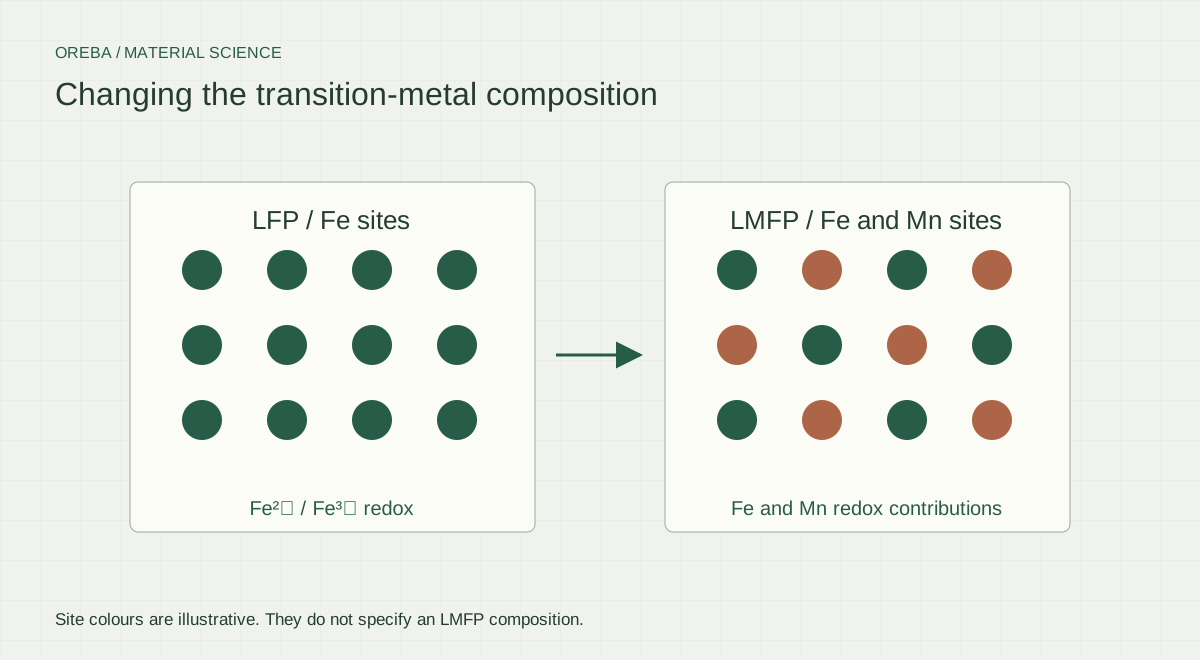
Lithium manganese iron phosphate, LMFP, is a family of compositions commonly written LiMnₓFe₁₋ₓPO₄. The manganese fraction is part of the material specification. The abbreviation alone does not identify a unique powder, electrode or cell. LFP is the iron end member, LiFePO₄; LiMnPO₄ is the manganese end member. [1]
The reason to introduce manganese is electrochemical: manganese contributes a higher-potential redox reaction within a related phosphate framework. The resulting energy benefit depends on whether that additional reaction can be accessed reversibly at the required current and within a compatible cell. The LMFP reference gives the basic composition and terminology.
What changes in the redox reaction
LFP exchanges lithium through the Fe²⁺/Fe³⁺ couple. Introducing manganese adds a Mn²⁺/Mn³⁺ contribution. A modern olivine review discusses representative working potentials near 3.4 V for LFP and 4.1 V for LiMnPO₄, both relative to Li/Li⁺. These are electrode-level reference values, rather than universal full-cell nominal voltages. [1]
An LMFP voltage profile can contain contributions associated with both metals. Their relative sizes and the measured polarization depend on composition and electrode conditions. Increasing manganese content changes the available redox contribution, but does not guarantee that every nominal site contributes equally during a practical discharge.
Both end members have approximately one electron available per ideal formula unit in this reaction picture. Replacing iron with manganese changes molar mass only modestly, as can be checked from standard atomic weights. The principal motivation is therefore the higher-potential contribution, rather than a doubling of charge capacity per formula unit. [2] [5]
Energy requires a usable voltage profile
Delivered electrical energy is obtained by integrating discharge voltage over exchanged charge:
With in volts and in ampere-hours, energy is in watt-hours. The approximation uses an average discharge voltage over the stated operating range. This relationship follows from the definition of electrical work; it is not an experimental result for a particular LMFP cell.
A higher cathode potential can increase the material’s energy potential. The usable integral also depends on polarization, cutoff voltages and the negative electrode. If a high-potential reaction cannot deliver charge at the required rate, its theoretical contribution is not fully recovered.
Mass and volume boundaries matter too. The active cathode, coated powder, complete electrode and assembled cell have different denominators. Comparing an LMFP active-material estimate with an LFP cell specification would not establish a chemistry advantage. The energy-storage reference explains these boundaries.
Transport and structural response
The shared olivine framework does not make all compositions equally conductive. Electronic and ionic transport remain central questions in manganese-containing phosphates. The 2024 review discusses slower kinetics in the manganese end member and structural distortion associated with oxidized Mn³⁺. These concerns motivate particle engineering, composition control and surface modification. [1]
Directional lithium motion in the LFP end member has experimental support along [010]. That result is useful background for the structural family. It should not be used to assign one diffusion coefficient to every mixed iron–manganese composition. Local composition, defects, lithium content and the measurement method still need to be specified. [4]
Iron and manganese distribution also matters when describing a sample. A nominal formula is not a measurement of uniform cation distribution within each particle. A structural comparison should therefore state what characterization establishes the composition and phase identity.
Carbon coatings and composite design
Carbon provides an electronic connection around active particles and through the electrode. Its structural characteristics and distribution affect performance, as demonstrated in LFP/carbon composite studies. Applying that principle to LMFP is an electrode-design consideration; the performance of a specific LMFP composite must be measured directly. [3]
Coating and particle-size strategies carry costs in inactive mass, processing and packing. A material that achieves good rate performance in a thin, carbon-rich electrode needs further evaluation at practical loading and density. The carbon-coating article discusses how to read these trade-offs.
A comparison that can be checked
The following questions keep a chemistry comparison tied to the actual test:
| Comparison point | Information needed |
|---|---|
| Composition | Manganese fraction, phase identity and evidence for elemental distribution |
| Capacity | Mass basis, voltage range, current and whether the test is a half-cell or full cell |
| Energy | Full discharge profile, negative electrode and the mass or volume boundary |
| Rate behaviour | Electrode loading, porosity, conductive fraction and temperature |
| Durability | Cycling and storage conditions, diagnostic methods and end-of-life criterion |
A useful result could show higher delivered energy under matched conditions, or a trade-off between energy and rate capability. It could also show that the electrode formulation dominates a particular comparison. The evidence should decide which conclusion is warranted. “LMFP” and “LFP” identify material families, not a complete ranking of finished batteries.
References
Unveiling olivine cathodes for high energy-density lithium-ion batteries: a comprehensive review from the atomic level to the electrode scale. Journal of Materials Chemistry A, 2024. DOI: 10.1039/D4TA02338B.
Publisher or institutional record ↗Phospho‐olivines as Positive‐Electrode Materials for Rechargeable Lithium Batteries. Journal of The Electrochemical Society, 1997. DOI: 10.1149/1.1837571.
Publisher or institutional record ↗Factors Influencing the Quality of Carbon Coatings on LiFePO4. Journal of The Electrochemical Society, 2007. DOI: 10.1149/1.2667591.
Publisher or institutional record ↗Experimental visualization of lithium diffusion in LixFePO4. Nature Materials, 2008. DOI: 10.1038/nmat2251.
Publisher or institutional record ↗Standard atomic weights. CIAAW / IUPAC, 2024.