
Olivine Cathodes
Olivine cathodes: why the crystal structure matters
How phosphate groups, transition-metal sites and directional lithium pathways connect olivine crystal structure with particle and electrode performance.
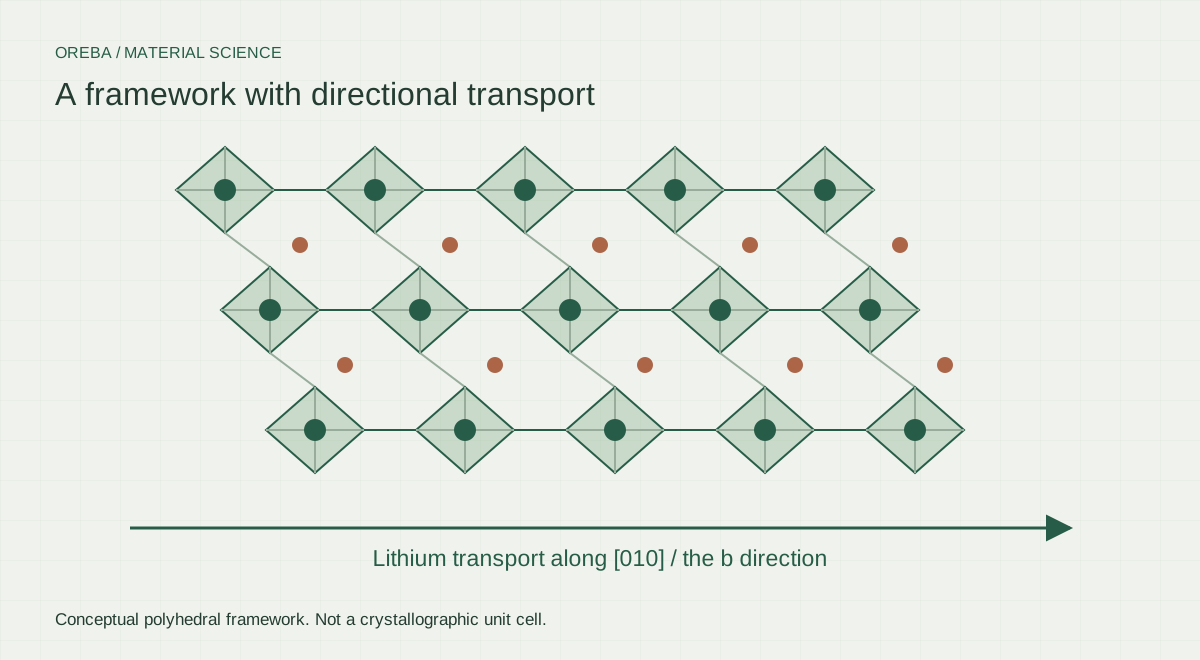
“Olivine” describes a structural family. In battery research, the term often refers to lithium transition-metal phosphates of the LiMPO₄ family, including LiFePO₄ and LiMnPO₄. The chemical composition and the arrangement of atoms both matter: a familiar formula alone does not establish which crystal structure a sample has. [1] [2]
The structure provides a starting point for understanding voltage, lithium motion and mechanical response. Electrode performance then depends on how particles of that material are connected and used. The olivine-cathode reference places these questions alongside the individual chemistries.
Phosphate groups and distinct cation sites
LFP is an orthorhombic material commonly described in the Pnma space group. Its framework contains PO₄ tetrahedra and coordination environments for lithium and iron. Lithium and transition-metal ions occupy different crystallographic sites. Oxygen links the local coordination units into the host structure. [2]
The strong phosphorus–oxygen bonding helps distinguish a phosphate electrode from a layered transition-metal oxide. That difference affects structural stability and the electronic environment of the redox-active metal. “Polyanion” refers to the multi-atom anionic group, here phosphate, rather than to a complete battery construction.
A schematic can explain the existence of separate sites and connected pathways. It cannot determine atomic coordinates, bond lengths or occupancies. Those require crystallographic measurements and refinement. The illustration above deliberately omits numerical unit-cell dimensions so that its geometry cannot be mistaken for measured structural data.
Why transport has a direction
The arrangement of lithium sites creates preferred migration pathways. In ideal bulk LFP, the experimentally visualized pathway follows [010], the crystallographic b direction. Nishimura and colleagues obtained this evidence using high-temperature neutron diffraction and a reconstruction of nuclear density. The result supports a curved one-dimensional chain of lithium motion. [3]
This directional picture gives particle shape a physical meaning. Two particles with a similar overall diameter can have different dimensions along the relevant transport direction. Their accessible surface facets and local defect distributions can also differ. A particle-size label alone cannot describe all of these features.
Directional transport also makes channel obstruction relevant. Atomistic investigations, including the work of Islam and colleagues, examine the role of defects and dopants in the framework. A common defect discussed in the broader olivine literature is transition-metal occupancy of a lithium site, often called an antisite defect. Such occupancy can hinder a preferred transport route. [2] [4]
The useful distinction is between an ideal pathway and a real particle. Real particles have surfaces, grain boundaries, finite dimensions and sometimes off-stoichiometric regions. Their response cannot be inferred from a perfect-crystal drawing alone.
Lithium content changes the phase behaviour
Charging changes lithium content and iron oxidation state. Equilibrium lithium-rich and lithium-poor states need not form a uniform continuously varying composition throughout every particle. Yamada and colleagues studied the room-temperature miscibility gap in LiₓFePO₄, placing phase coexistence at the centre of the LFP reaction picture. [5]
Under current, the material can follow a reaction pathway that differs from an equilibrium construction. Malik and colleagues investigated non-equilibrium lithium incorporation, while modern reviews discuss the importance of particle scale and reaction kinetics. Equilibrium phase diagrams and operating electrodes answer related but distinct questions. [6] [2]
This distinction matters when interpreting a voltage profile. A flat region can be associated with the reaction thermodynamics, while polarization, composition heterogeneity and measurement conditions influence the observed curve. A profile is not an image of the microscopic phase distribution.
Electronic contact and electrode architecture
Lithium transport is only part of the reaction. Electrons must reach or leave the active material through a conducting network. In LFP electrodes, carbon coatings and conductive additives help establish this connection. They do not change the need for lithium to move through the relevant parts of the particle. [2]
The carbon-coating discussion distinguishes a particle coating from the electrode-wide network. The diffusion discussion distinguishes a local migration process from an apparent transport quantity extracted from a porous electrode.
A thicker electrode contains more active material per unit area but also changes the distances travelled by ions and electrons. Porosity, binder distribution and particle contacts become part of the measured result. The crystal structure supplies constraints; the electrode architecture determines how the material is accessed in a particular test.
Using structure to compare olivine chemistries
Replacing some iron with manganese creates LMFP compositions within the phosphate family. The framework remains a useful common reference, while the redox contribution, local distortions and transport behaviour depend on composition. The LFP–LMFP comparison examines why a higher electrode potential does not by itself specify a better finished cell. [2]
Structural evidence should be read alongside electrochemical context. A claim about improved crystallinity, lower defect content or altered lattice parameters needs a measurement that supports that specific change. The subsequent claim about electrode performance needs its own test conditions. Keeping those links explicit makes a structure–property argument possible to assess.
References
Phospho‐olivines as Positive‐Electrode Materials for Rechargeable Lithium Batteries. Journal of The Electrochemical Society, 1997. DOI: 10.1149/1.1837571.
Publisher or institutional record ↗Unveiling olivine cathodes for high energy-density lithium-ion batteries: a comprehensive review from the atomic level to the electrode scale. Journal of Materials Chemistry A, 2024. DOI: 10.1039/D4TA02338B.
Publisher or institutional record ↗Experimental visualization of lithium diffusion in LixFePO4. Nature Materials, 2008. DOI: 10.1038/nmat2251.
Publisher or institutional record ↗Atomic-Scale Investigation of Defects, Dopants, and Lithium Transport in the LiFePO4 Olivine-Type Battery Material. Chemistry of Materials, 2005. DOI: 10.1021/cm050999v.
Publisher or institutional record ↗Room-temperature miscibility gap in LixFePO4. Nature Materials, 2006. DOI: 10.1038/nmat1634.
Publisher or institutional record ↗Kinetics of non-equilibrium lithium incorporation in LiFePO4. Nature Materials, 2011. DOI: 10.1038/nmat3065.
Publisher or institutional record ↗