
Cathode Chemistry
Lithium manganese iron phosphate: LMFP
A technical reference for LMFP cathodes: manganese–iron composition, redox voltage, transport constraints and how to compare practical energy with LFP.
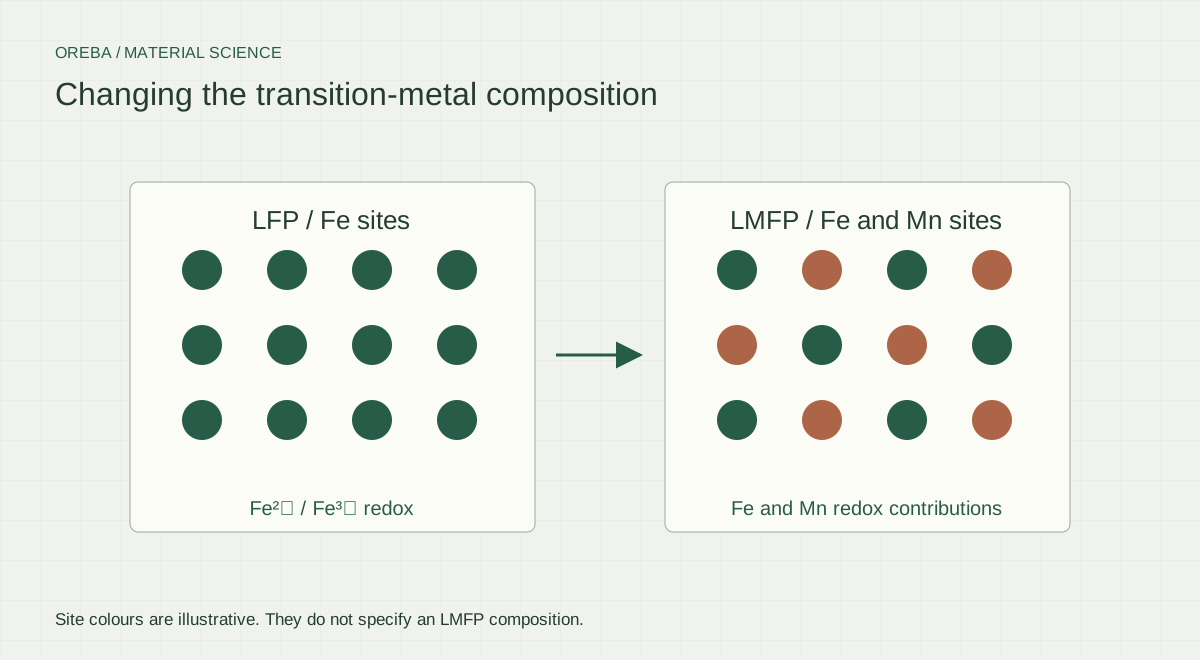
LMFP denotes lithium manganese iron phosphate, commonly written LiMnₓFe₁₋ₓPO₄. The variable is the fraction of transition-metal sites assigned to manganese in this convention. It must be reported: “LMFP” alone does not specify one composition.
Manganese introduces a redox contribution at a higher potential than iron in the olivine phosphate family. The 2024 review by Hwang and colleagues discusses approximate iron and manganese potentials of 3.4 and 4.1 V versus Li⁺/Li, together with the transport and electrode issues that affect utilization. These are chemistry reference values, not a promised cell voltage. [1]
Higher potential and accessible charge
Energy is obtained by integrating voltage over delivered charge. A higher-potential reaction increases energy only to the extent that its charge is accessible under the intended conditions. Polarization, voltage limits and reaction kinetics affect that accessibility.
This is why an LMFP comparison should show the discharge profile as well as total capacity. Temperature and rate may change which parts of the reaction contribute within the cutoffs. A single average voltage can conceal the loss of accessible charge at a demanding duty.
The LFP–LMFP article develops the distinction between stoichiometric capacity, electrode-level energy and complete-cell performance. Its comparison framework requires the same mass basis and equivalent operating conditions.
Composition is only part of the specification
Phase identity, particle size, elemental distribution and carbon treatment matter alongside the manganese fraction. Different synthesis routes can produce different distributions of manganese and iron or different impurity phases. Structural and compositional measurements are needed before attributing a performance change solely to .
Lithium transport remains a framework question. Experimental visualization of lithium motion in LiₓFePO₄ provides a reference for directional transport in the olivine family, while a particular LMFP composition needs its own evidence. An LFP diffusion measurement should not become an LMFP material constant. [3]
Conductive composites and higher-voltage interfaces
Electronic access involves the carbon structure and contacts between particles. Wilcox and colleagues’ LFP carbon-coating study is a useful methodological example: composite behaviour should be related to carbon properties rather than only its amount. It does not establish an optimal coating for every LMFP composition. [2]
The higher-potential portion of LMFP operation also makes the electrolyte and surface chemistry part of the comparison. A formulation that works for a chosen LFP voltage window requires reassessment when that window changes. [1]
A practical reading path
Use the olivine reference for shared structural concepts and the LFP reference for the iron-only baseline. Then compare composition-resolved LMFP results, specifying active fraction, loading, cell configuration and test conditions. The publications library contains the review used here, with its bibliographic record and primary-source link.
References
Unveiling olivine cathodes for high energy-density lithium-ion batteries: a comprehensive review from the atomic level to the electrode scale. Journal of Materials Chemistry A, 2024. DOI: 10.1039/D4TA02338B.
Publisher or institutional record ↗Factors Influencing the Quality of Carbon Coatings on LiFePO4. Journal of The Electrochemical Society, 2007. DOI: 10.1149/1.2667591.
Publisher or institutional record ↗Experimental visualization of lithium diffusion in LixFePO4. Nature Materials, 2008. DOI: 10.1038/nmat2251.
Publisher or institutional record ↗