
Degradation & Safety
LFP battery degradation: calendar ageing, cycling and temperature
Understand ageing in LFP/graphite cells by separating cathode behaviour, graphite interfaces, lithium inventory loss and the effects of storage and cycling.
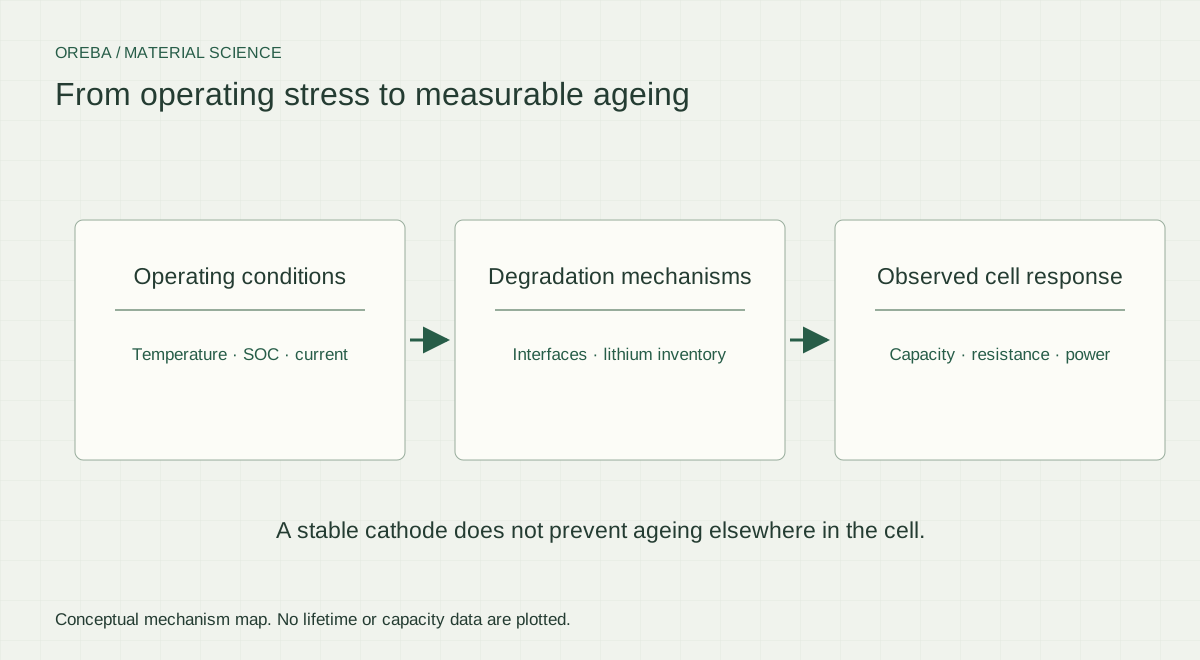
An LFP/graphite cell can lose usable capacity while much of its LFP cathode remains electrochemically active. Lithium can be consumed by side reactions, interfaces can change and resistance can increase elsewhere in the cell. Naming the cathode does not identify the mechanism responsible for every observed loss.
Calendar ageing and cycle ageing describe operating histories. They are not separate lists of chemical reactions. Some of the same reactions occur during storage and cycling, with different rates and interactions. A useful diagnosis distinguishes an underlying mechanism from the cell-level response that it produces. [1]
Capacity loss and resistance growth
Loss of lithium inventory means that less lithium remains available for the reversible reaction between the electrodes. Loss of active material means that some material no longer contributes effectively, for example because it is damaged or electrically disconnected. These changes can shift the usable balance between electrodes.
Resistance growth can reduce power and cause a cell to reach a voltage limit earlier during a discharge. The measured capacity at a high current can therefore fall without the same decrease in low-rate accessible capacity. Capacity, energy and power tests should be interpreted with their current, temperature and cutoff conditions stated. [1]
For a capacity-retention calculation,
is the baseline measured capacity and is the capacity at the later test. The ratio is meaningful only when the measurements use comparable procedures. It is an accounting relationship; it does not identify which mechanism caused the change.
The graphite electrode remains part of the explanation
At a graphite negative electrode, the solid-electrolyte interphase, or SEI, forms from electrolyte reactions. Continued SEI growth can consume cyclable lithium and electrolyte. The resulting changes affect lithium inventory and transport. A stable positive-electrode framework does not prevent those reactions. [1]
Lithium plating is another negative-electrode process. Metallic lithium can form when the conditions favour deposition over insertion into graphite. Low-temperature charging, high charge current and the state of the negative electrode influence this risk. Plated lithium can subsequently react or become electrically isolated, contributing to irreversible loss. This is a mechanism of the complete cell, rather than a property established by the LFP formula alone. [1]
The lithium-ion reference explains the normal transport routes. Keeping that operating picture in view helps locate side reactions at the relevant electrode or interface.
What storage tests establish
Calendar-ageing studies hold cells under specified storage conditions and periodically measure their response. Temperature and state of charge are part of the test definition. A result obtained at one storage condition cannot be converted into a universal lifetime for all LFP batteries.
Naumann and colleagues studied calendar ageing of a commercial LFP/graphite cell and developed a model around that experimental system. Such work supports analysis of a defined cell and operating range. Applying its model to another cell requires examining whether its parameters and mechanisms remain appropriate. [3]
Storage state of charge is a cell-level measure. Its relationship to the potential and lithiation of each electrode depends on the cell’s design and ageing state. This is one reason that cell identification and electrode balance belong in a careful interpretation of storage results.
What cycling tests establish
A cycling protocol specifies current, voltage limits, depth of discharge, rest periods and temperature. It can also change the relative amount of time a cell spends at particular states of charge. Two cells that complete the same number of cycles need not have exchanged the same charge or spent the same time under comparable stress.
Safari and Delacourt investigated a commercial 2.3 Ah graphite/LFP cell during cycling or storage at 25 and 45 °C. Their reported capacity fade was greater at the higher temperature under the investigated conditions. These temperatures and capacity identify the study’s context; they are not a product recommendation or a universal temperature–lifetime rule. [2]
Wang and colleagues developed a cycle-life model for graphite/LFP cells. A model’s prediction depends on its calibration data and assumptions. An acceptable fit to one set of cells does not establish equivalent behaviour for different electrolyte formulations, electrode loadings or operating windows. [4]
Temperature and cathode–electrolyte conditions
High temperature can accelerate reactions, while low temperature can impair transport and change charging behaviour. The adverse mechanism depends on the operating mode: a storage test and a rapid low-temperature charge do not pose the same problem. The degradation reference provides the broader mechanism map. [1]
The LFP positive electrode also interacts with its electrolyte. Koltypin and colleagues examined olivine stability under different electrolyte and temperature conditions. Their study is a reminder to describe the material together with its environment when discussing stability. [5]
These questions also remain active conference subjects. The OREBA III programme listed a talk on high-temperature degradation in LFP/graphite cells. A programme title establishes the topic of a presentation, not its experimental conclusions; the underlying research must be consulted for those conclusions. [6]
Diagnosing the limiting process
Capacity checks, impedance measurements and voltage-curve analysis reveal different aspects of ageing. A declining capacity alone rarely separates lithium inventory loss from active-material loss or transport limitations. Stronger diagnoses combine complementary measurements and preserve the operating history.
A lifetime statement should name the tested cell, protocol and end-of-life criterion. Reporting those details allows readers to judge relevance to their application. A chemistry-wide cycle count omits the information needed to make that judgment.
References
Lithium ion battery degradation: what you need to know. Physical Chemistry Chemical Physics, 2021. DOI: 10.1039/D1CP00359C.
Publisher or institutional record ↗Aging of a Commercial Graphite/LiFePO4 Cell. Journal of The Electrochemical Society, 2011. DOI: 10.1149/1.3614529.
Publisher or institutional record ↗Analysis and modeling of calendar aging of a commercial LiFePO4/graphite cell. Journal of Energy Storage, 2018. DOI: 10.1016/j.est.2018.01.019.
Publisher or institutional record ↗Cycle-life model for graphite-LiFePO4 cells. Journal of Power Sources, 2011. DOI: 10.1016/j.jpowsour.2010.11.134.
Publisher or institutional record ↗On the Stability of LiFePO4 Olivine Cathodes under Various Conditions (Electrolyte Solutions, Temperatures). Electrochemical and Solid-State Letters, 2007. DOI: 10.1149/1.2403974.
Publisher or institutional record ↗OREBA III: conference agenda. OREBA3, 2025.