
Cell Science
Solid-state batteries and olivine cathodes: contact, interfaces and compatibility
Examine how an olivine cathode works inside a solid-state composite, separating electronic contact, ion conduction, interfacial reactions and cell-level evidence.
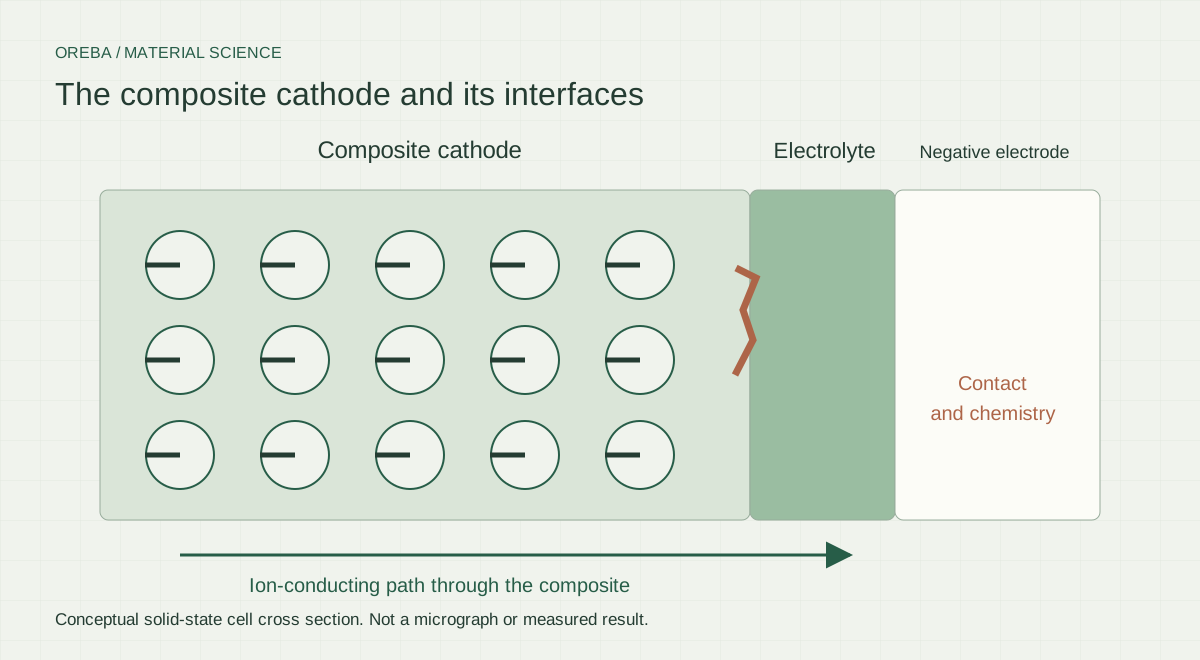
An olivine cathode in a solid-state battery still needs access to lithium ions and electrons. Replacing a liquid electrolyte with a solid changes how those routes are formed and maintained. A material with useful redox behaviour in a liquid-electrolyte cell does not automatically form a well-functioning solid-state composite.
The central questions concern contact, interfacial chemistry and the complete cell design. A review by Xiao and colleagues distinguishes the conductivity of solid electrolytes from the stability of their interfaces with active materials and conductive additives. High bulk ionic conductivity can coexist with poor cell performance when the interfaces dominate the resistance. [1]
The composite cathode needs connected pathways
The active phosphate supplies the redox reaction. A solid ion conductor carries lithium through the composite, and an electronic conductor connects the active material to the current collector. These networks must reach appropriate parts of the active particles while avoiding unwanted electronic pathways across the separator layer.
In a liquid-electrolyte electrode, liquid can wet pores and access particle surfaces. In a solid composite, contacts are established through processing and mechanical arrangement. The fraction of active material that has suitable contacts can therefore differ from the total fraction placed in the mixing vessel.
This creates a compositional trade-off. Adding more solid electrolyte may improve ionic access but lowers the active-material fraction. Adding conducting carbon may improve electronic access but also creates additional electrolyte–carbon interfaces. The requirements need to be considered together. [1]
The carbon-coating article explains the electronic problem in LFP. The olivine reference explains why particle geometry and lithium pathways remain relevant after the electrolyte is changed.
Chemical compatibility differs from physical contact
Two solids can touch without forming a chemically stable interface. The applied electrode potential and the chemical affinity of the materials can drive electrolyte decomposition or other interfacial reactions. A contact improvement does not establish that the resulting interface is stable during charging.
An interphase is the material formed between the original components. Its consequences depend on whether it conducts lithium, conducts electrons and allows the reaction to continue. A passivating layer can limit further reaction while allowing lithium transport; a mixed conducting reaction layer can allow continued decomposition. These are different chemical outcomes. [1]
“Stable electrolyte” should therefore name the neighbouring material and the relevant potential range. Stability next to lithium metal does not establish stability at a positive electrode, and the reverse is also true. Each side of the cell needs its own evidence.
Processing and mechanical conditions matter
Oxide, sulfide and polymer electrolytes have different processing and contact requirements. They should not be treated as one interchangeable material class. The solid-state reference introduces these electrolyte families and the questions used to evaluate them. [4]
Heating and mechanical compression can change contact and chemical reactions. During cycling, dimensional changes and local current distribution can alter the same contacts. A report should state how the composite was processed and what pressure, if any, was applied during its test.
The practical question is whether the required conditions can be maintained in the intended cell architecture. A laboratory fixture that supplies continuous pressure is part of the experimental system. Its contribution cannot be omitted from a claim about a freely operating finished cell.
A solid does not guarantee freedom from short circuits
Porz and colleagues investigated lithium deposition and penetration in inorganic solid electrolytes. Their experiments linked infiltration to pre-existing defects and applied current conditions, rather than establishing that stiffness alone prevents lithium penetration. The study provides a specific reason to evaluate defects and mechanical–electrochemical interactions at the negative-electrode side. [2]
This evidence should not be generalized into a claim that every solid-state design fails in the same way. It also prevents the opposite assumption that replacing liquid with a solid automatically solves internal short circuits. The material, interfaces and operating conditions determine the relevant failure modes.
Cell-level evidence needs cell-level boundaries
An energy estimate using only the active cathode and lithium metal excludes other masses and volumes. Solid electrolyte, current collectors, excess electrode material and the construction needed to maintain contact contribute to the finished battery. Benchmarking work by Randau and colleagues provides a reference for examining all-solid-state battery performance. [3]
Rate and cycling comparisons also need comparable active loading, voltage range, temperature and mechanical conditions. A useful interface study may use a deliberately simplified cell. Its scientific value comes from isolating a question, while the move to practical cell design requires additional evidence.
The olivine research connection
Olivine materials contribute known phosphate redox chemistry to the solid-state cathode problem. Their electronic transport and particle-engineering requirements remain relevant, while the electrolyte interface adds constraints. The modern olivine review supplies the material and electrode background. [5]
The OREBA III programme included presentations on solid-state lithium-metal batteries and olivine-based cathodes for next-generation solid-state cells. These entries document the research intersection. They do not independently verify a performance claim from a presentation. [6]
A convincing solid-state result should establish which interface or network was changed, how that change was measured and what complete-cell conditions were maintained. That chain of evidence is more useful than treating the electrolyte’s physical state as a battery specification.
References
Understanding interface stability in solid-state batteries. Nature Reviews Materials, 2020. DOI: 10.1038/s41578-019-0157-5.
Publisher or institutional record ↗Mechanism of Lithium Metal Penetration through Inorganic Solid Electrolytes. Advanced Energy Materials, 2017. DOI: 10.1002/aenm.201701003.
Publisher or institutional record ↗Benchmarking the performance of all-solid-state lithium batteries. Nature Energy, 2020. DOI: 10.1038/s41560-020-0565-1.
Publisher or institutional record ↗A solid future for battery development. Nature Energy, 2016. DOI: 10.1038/nenergy.2016.141.
Publisher or institutional record ↗Unveiling olivine cathodes for high energy-density lithium-ion batteries: a comprehensive review from the atomic level to the electrode scale. Journal of Materials Chemistry A, 2024. DOI: 10.1039/D4TA02338B.
Publisher or institutional record ↗OREBA III: conference agenda. OREBA3, 2025.